The Databricks Data + AI Summit 2026 wrapped up this week in San Francisco, and it was one of the most consequential events the Databricks ecosystem has seen in years. Not because of any single announcement, but because of what the announcements signal collectively: the gap between Databricks and the Microsoft data ecosystem is closing fast.
At Collectiv, a Databricks partner and Microsoft Solutions Partner specializing in data and AI, we have been telling clients for a while that the Fabric vs. Databricks conversation is the wrong one to be having. These platforms are better together. The announcements from this summit make that case better than we ever could.
Here is our full breakdown of what’s new in Databricks 2026 and what it means for your organization.
The Fabric and Databricks Integration Story Got Real
The most significant announcement for organizations already invested in the Microsoft ecosystem was not the flashiest, but it may be the most impactful for day-to-day architecture decisions. Azure Databricks can now store Unity Catalog managed tables directly in Microsoft OneLake.
Until now, the most common pattern was storing data in ADLS Gen2 and surfacing it in Fabric through mirroring. That worked, but it introduced friction. Now, with OneLake as a native storage destination for Unity Catalog, data written by Azure Databricks lives directly in OneLake from the start. No separate storage systems. No duplicate pipelines. One copy of data, accessible across both platforms.
Paired with the new Publish to Fabric workflow, teams can surface Unity Catalog tables in any Fabric workspace directly from the Azure Databricks Catalog Explorer. Changes made in Databricks are reflected in Fabric at the next sync interval.
This is the architecture conversation we have been having with clients for years. Most organizations running both Fabric and Databricks have been managing two data estates and bridging between them. This announcement removes one of the last meaningful friction points in that architecture. It is the clearest signal yet that Fabric and Databricks are converging on a shared data foundation rather than competing for it.
As a Databricks partner with deep experience implementing Unity Catalog and Microsoft Fabric environments, Collectiv helps organizations design architectures that take advantage of exactly this kind of interoperability — so when capabilities like this arrive, clients are positioned to move quickly.
Lakehouse//RT: Real-Time Analytics Without a Separate Serving Layer
Databricks introduced Lakehouse//RT, a new real-time data warehouse built directly into the lakehouse and powered by a new engine called Reyden. The headline is millisecond query performance at scale, without a separate serving layer.
For most organizations, the alternative has been maintaining a dedicated real-time stack alongside the lakehouse. That means duplicated data, extra infrastructure, fragmented governance, and engineering time spent managing systems instead of building on them. In our work with enterprise data teams, this architectural complexity is one of the most common sources of cost overrun and technical debt we see.
Lakehouse//RT eliminates that trade-off. Real-time workloads now live on the same platform, the same open formats, and the same Unity Catalog governance model as everything else. Critically for Microsoft-focused organizations, Lakehouse//RT integrates directly with Power BI, enabling sub-second dashboard performance on live lakehouse data.
Early preview customers reported up to 16x better performance compared to previous real-time serving layers, with some queries returning in under 10 milliseconds. PointClickCare reported queries running more than 10 times faster on their healthcare dataset while maintaining consistent governance — a combination that is particularly relevant for the regulated industries we work with at Collectiv, including healthcare and financial services.
Genie Is Now Embedded in Microsoft Teams, M365 Copilot, and Excel
One of the most significant announcements for business users was the expansion of Genie, Databricks’ AI data assistant, into the Microsoft productivity suite. Genie is now available natively in Microsoft Teams, M365 Copilot, and Excel.
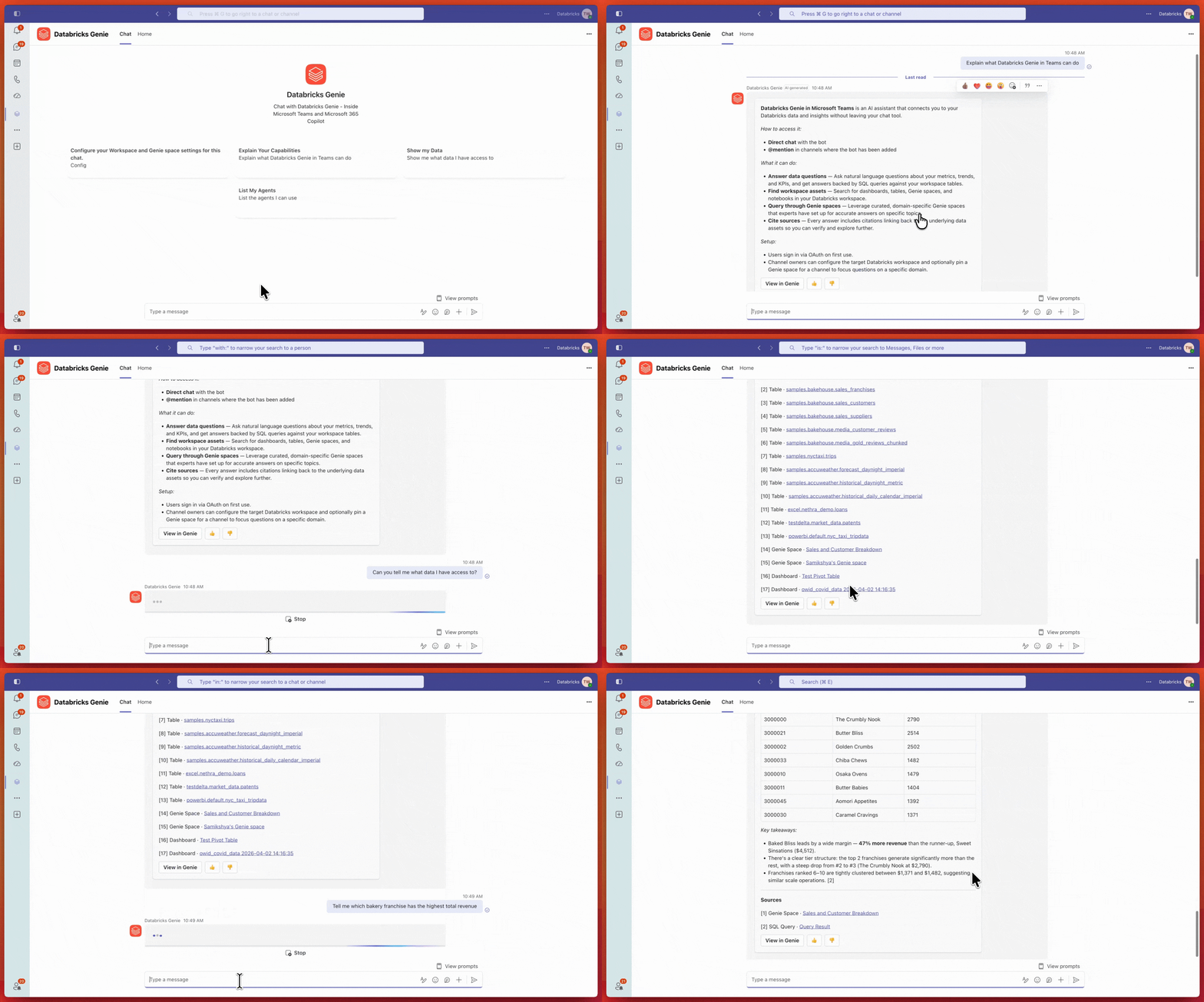
What this means in practice: a sales leader can tag Genie in a Teams conversation and get an answer sourced directly from the lakehouse in seconds. A finance team can query live business data from inside Excel without writing SQL or switching tools. Business users get governed, accurate answers grounded in real enterprise data, without leaving the applications they already work in every day.
One of the most consistent challenges we hear from clients is the gap between their data platform and the people who actually need to use it. Business users should not need to know where data lives or how to query it. This announcement closes that gap significantly for organizations already invested in the Microsoft ecosystem.
The Azure Databricks Excel Add-in, now in public preview, extends this further with Unity Catalog metric views, meaning business logic is defined once and made available in Excel and beyond, fully governed and consistent across the organization.
Unified AI Governance with Unity Catalog and Unity AI Gateway
As organizations move from AI experimentation to production deployment, governance becomes the defining challenge. Databricks addressed this directly with a major expansion of Unity Catalog at the 2026 summit.
Unity AI Gateway is now a centralized governance layer for models, agents, tools, and MCP services, sitting alongside data in Unity Catalog. Admins can enforce what AI can do at runtime, set hard spend caps across providers, and monitor agent activity in one unified view. Contextual Service Policies allow governance rules that respond to what an agent is actually doing, not just who is accessing what.
Genie Ontology adds a continuously learning context layer that automatically extracts business semantics from data, pipelines, and connected tools. In internal benchmarks, Genie answered 84.5% of real-world enterprise data questions correctly on the first attempt, compared to 52.4% for the strongest general-purpose coding agent tested.
Collectiv’s Databricks consulting practice includes Unity Catalog deployment and governance architecture as a core service area — covering multi-workspace Unity Catalog deployment, fine-grained access controls, and compliance architecture for HIPAA, GDPR, and SOC 2 standards. The expansion of Unity Catalog into AI governance makes that foundation even more valuable for organizations building toward enterprise AI.
What Else Is New in Databricks 2026
Beyond the four headline areas above, the summit included several additional announcements worth noting:
Lakeflow — Databricks’ unified data engineering platform now supports 100+ native connectors, real-time streaming with latency as low as 5 milliseconds, and agentic pipeline development through Genie Code and Lakeflow Designer. Genie ZeroOps extends automation into production operations, monitoring live systems and preparing fixes for human review.
Agent Bricks — Now a full agent development platform with 100,000+ agents built since launch and more than one quadrillion tokens processed per year. It covers model choice across all major frontier providers including OpenAI, Anthropic, Gemini, and Grok, context grounding through Genie Ontology and Unity Catalog, and enterprise governance through Unity AI Gateway.
OpenSharing — The next evolution of Delta Sharing, now an open-source Linux Foundation project. OpenSharing extends the protocol to share not just data but models, agents, and AI skills across any cloud, vendor, or format. It currently has 28,000+ data recipients with 33% of shares flowing across platforms via open connectors.
Databricks Free Edition — Expanded to include every core practitioner feature: Genie Code, serverless GPUs, Lakebase, Agent Bricks, and Lakeflow Designer. More than 500,000 people have used Free Edition since launch, receiving $10M+ in free credits.
AI Runtime — Now in public preview with support for high-performance multinode GPU training on serverless A10 and H100 GPUs, enabling teams to go from notebook to training job in 2-3 clicks with no cluster management required.
What This Means for Your Data Platform Strategy
The through-line across all of these announcements is consistent: less architectural complexity, more capability, and a data foundation built to support AI at scale.
For organizations running Databricks today, many of these capabilities are available now or arriving in the coming months. For organizations still evaluating their platform strategy, the direction is clear. What’s new in Databricks 2026 is not a set of isolated product updates. It is a platform maturing toward a unified architecture that works alongside Microsoft Fabric rather than against it.
Collectiv works with enterprise data teams across industries to implement, manage, and optimize Databricks environments, from initial architecture and Unity Catalog deployment to ongoing managed services, performance optimization, and AI enablement. As a Databricks Brickbuilder Partner and Microsoft Solutions Partner, we bring both platform depth and cross-ecosystem expertise to every engagement.
The organizations that will get the most out of these announcements are the ones with the right architecture already in place to take advantage of them — and the right partners to help them get there.
Frequently Asked Questions: What’s New in Databricks 2026
What were the biggest announcements at the Databricks Data + AI Summit 2026?
The biggest announcements include Lakehouse//RT (real-time analytics directly on the lakehouse), the expansion of Genie into Microsoft Teams, M365 Copilot, and Excel, OneLake interoperability enabling Azure Databricks to store Unity Catalog managed tables directly in Microsoft OneLake, Unity AI Gateway for centralized AI governance, Lakeflow updates with 100+ native connectors, and the expansion of Agent Bricks into a full enterprise agent platform.
What is Lakehouse//RT and how does it work?
Lakehouse//RT is Databricks’ new real-time data warehouse built directly into the lakehouse, powered by a new engine called Reyden. It delivers millisecond query performance at scale without requiring a separate serving layer or data movement. Organizations can support real-time dashboards and applications on the same data, governance model, and open formats used for all other analytics workloads. It integrates directly with Power BI for sub-second reporting on live lakehouse data.
Can Databricks and Microsoft Fabric work together?
Yes. The 2026 summit announcements significantly advanced Fabric and Databricks interoperability. Azure Databricks can now store Unity Catalog managed tables directly in Microsoft OneLake, eliminating the need for separate storage systems. The new Publish to Fabric workflow allows teams to surface those tables across all Fabric workloads including Power BI, SQL analytics, and notebooks, with no data duplication or movement required.
What is Genie and what Microsoft tools does it now work with?
Genie is Databricks’ AI data assistant that allows business users to ask questions about their enterprise data in plain language. As of the 2026 Data + AI Summit, Genie is now natively embedded in Microsoft Teams, M365 Copilot, and Excel. Users can tag Genie in Teams conversations or query live lakehouse data from inside Excel without switching tools or writing SQL. All responses are governed through Unity Catalog.
What is Unity AI Gateway?
Unity AI Gateway is Databricks’ centralized governance layer for AI assets. It sits inside Unity Catalog and allows organizations to register and govern models, agents, tools, and MCP services alongside their data. Admins can set runtime policies controlling what AI agents can and cannot do, enforce hard spend caps across providers, and monitor all agent activity through unified telemetry. It is designed to make AI governance systematic rather than ad hoc as organizations scale their AI programs.
What is Genie Ontology?
Genie Ontology is a continuously learning context layer built into the Databricks platform. It automatically extracts business semantics from tables, queries, dashboards, pipelines, and connected applications, building a living understanding of what your data means and how your organization uses it. In internal Databricks benchmarks, Genie answered 84.5% of real-world enterprise data questions correctly on the first attempt, compared to 52.4% for the strongest general-purpose coding agent tested.
What is Lakeflow?
Lakeflow is Databricks’ unified data engineering platform covering ingestion, transformation, and orchestration in one place. At the 2026 summit, Databricks announced that Lakeflow Connect now supports 100+ native connectors across enterprise applications, databases, and cloud storage. Lakeflow also includes Genie Code for AI-assisted pipeline development, Genie ZeroOps for autonomous production operations, and Real-Time Mode for Spark Declarative Pipelines with end-to-end latency as low as 5 milliseconds.
What is OpenSharing?
OpenSharing is the next evolution of Delta Sharing, announced at the 2026 Data + AI Summit and now hosted as an open-source project under the Linux Foundation. It extends the original Delta Sharing protocol to support sharing of not just data but AI models, agents, and skills across any cloud, vendor, or data format. It includes Genie Agent Sharing for sharing governed AI experiences across organizational boundaries, SecureConnect for simplified cross-cloud networking, and Apache Iceberg interoperability.
Should I use Microsoft Fabric or Databricks?
The better question is how to use both. Fabric and Databricks are increasingly designed to work together rather than as competing alternatives. The 2026 announcements — particularly OneLake interoperability, Lakehouse//RT’s Power BI integration, and Genie’s embedding in Microsoft tools — reflect a shared direction between Microsoft and Databricks toward a unified data foundation. Most organizations benefit from a complementary architecture that leverages the strengths of each platform rather than choosing one over the other.
What Databricks services does Collectiv offer?
Collectiv is a Databricks Brickbuilder Partner offering end-to-end Databricks consulting and managed services. Services include Unity Catalog deployment and governance architecture, data engineering and ETL management, AI and machine learning implementation, Databricks SQL and business intelligence enablement, migration and replatforming from legacy platforms, and ongoing managed services covering performance optimization, cost management, and platform administration. Collectiv also integrates Databricks environments with the broader Microsoft data ecosystem including Azure, Microsoft Fabric, and Power BI.
Ready to Talk Through What This Means for Your Architecture?
Collectiv helps organizations design and implement Fabric and Databricks architectures that work together. Whether you are evaluating your current platform strategy, planning a migration, or looking to get more out of an existing Databricks environment, our team brings the cross-platform expertise to move quickly and build right. Schedule a Fabric + Databricks architecture conversation.